

Debate Begins on the Marketplace Fairness Act
![]() |
Is the Party Over for Online Retailers?
Online retailers have revolutionized the way today’s consumers shop. People of all ages are discovering that shopping online is safe, convenient, and often less expensive than shopping at conventional “brick and mortar” stores. This new industry is still in its infancy, but its growth is nothing short of spectacular. The U.S. Bureau of the Census estimated there were $4.1 trillion in retail and wholesale transactions over the Internet in 2010 and this number is expected to get much larger in the years ahead.
Since current sales tax laws typically only apply to goods and services purchased in the seller’s home state, new Internet businesses have benefited by selling their products tax free to out-of-state customers. Until recently, politicians have supported this practice, because it encouraged the growth of a whole new type of industry and politicians know that business growth means new jobs.
Potential Revenue Gains
Opinions are changing however, and the party may soon be over for Internet retailers. Traditionally, state governments have relied on sales and use taxes for roughly a third of their total tax revenue. Local governments depend on sales taxes too, and derive over 11% of their tax revenue from sales and use taxes. With online sales booming, these governments are seeing a dramatic decline in revenue. It is estimated that Internet transactions were responsible for an estimated loss of $11.4 billion dollars in revenue to state and local governments throughout the United States in 2012.
With a stagnant economy and declining revenues, governments are looking for money anywhere they can find it. One place they are turning is online sales. Many legislators think that taxing online sale will level the playing field and be beneficial to traditional “brick and mortar” business in their constituencies. That is why large retailers like Walmart currently support an online sales tax. Many legislators aren’t as concerned about this perceived “fairness” issue. They just see online sales as an enormous new source of potential revenue.
Possible Consequences for Small Businesses
Although a few larger online retailers like Amazon support the concept of an online sales tax, the tax could be devastating for smaller retailers. Many think it would be an administrative nightmare to comply with an online sales tax law, since each state and municipality has their own tax laws. With thousands of different tax jurisdictions, each imposing their own tax rate, it could be extremely complex for sellers to deal with a different set of rules for every out-of-state buyer.
Inevitable Outcome?
Despite the complexities, the Marketplace Fairness Act has strong bipartisan support in congress and the legislation is expected to pass as early as May 6. With government at every level hungry for new sources of revenue, it’s hard to find opposition to the proposed Internet sales tax. Even those who have pledged not to increase taxes tend to support this bill, saying that it is not a new tax, but simply a mechanism that allows states to more effectively enforce existing tax laws.
With online sales continuing to grow at an astounding 16% a year, it is increasingly clear that state and local governments are going to want a share of this lucrative pie.
About Gevril Group
Gevril Group is the exclusive US representative for select European watch brands, distributing and servicing luxury, fashion and sports timepieces at a wide range of price points. Gevril Group also operates a full-service watch repair department staffed by master Swiss watchmakers.
Please subscribe to the Gevril Group newsletter and blog updates. Reader comments are welcome.
China Haidian Holdings Acquires Corum
![]() |
Is Corum’s Move to China a Sign of Things to Come?
When Chinese watchmaker China Haidian Holdings purchased Eterna AG in 2011, the Swiss watch industry immediately took notice. Eterna was a major player in the world of luxury timepieces. The company was famous for developing the ubiquitous ETA movement. Without Eterna, there wouldn’t be an ETA movement in the vast majority today’s fine mechanical watches.
Now, China Haidian Holdings has consolidated its position in the luxury Swiss watch sector with the purchase of another Swiss icon: the popular luxury watchmaker Corum. China Haidian announced on April 24, that it had acquired 100% of Corum for 86 million Swiss francs (US $90.9 million). Corum timepieces are well known for their gold and jewel encrusted designs and the brand is quite popular with celebrities and watch aficionados. In a prepared statement China Haidian chief executive Hon Kwok Lung said, “I am very pleased with this acquisition and I firmly believe in the potential development of Corum.”
Is the Future of the Watch Industry in China?
China Haidian Holdings already owns two of the top four domestic Chinese watch brands, EBOHR and ROSSINI. In addition to owning the Swiss brand Eterna, Haidian also has a license to manufacture and distribute “Porsche Design” watches globally as well as distribute various other luxury watches in China.
With the Far East currently the strongest market for timepieces worldwide, watch industry insiders are looking closely at these Chinese acquisitions and wondering what they mean for the future. Many see Chinese acquisitions like Eterna and Corum a win-win proposition for all involved. The Chinese get access to hundreds of years of Swiss watchmaking knowledge and expertise. The newly acquired companies gain access to new and better manufacturing methods, along with an opportunity to more effectively market their products to the all-important Asian audience.
With wristwatches continuing to grow in popularity as a fashion accessory, many see a bright future for Swiss and Chinese companies alike.
About Gevril Group
Gevril Group is the exclusive US representative for select European watch brands, distributing and servicing luxury, fashion and sports timepieces at a wide range of price points. Gevril Group also operates a full-service watch repair department staffed by master Swiss watchmakers.
Please subscribe to the Gevril Group newsletter and blog updates. Reader comments are welcome.
Gold Prices Plummet to New Lows
![]() |
Has Gold Lost its Glitter With Investors?
It has been a tough week for gold investors. The precious metal has tumbled to its lowest level since March of 2011, with prices falling below the benchmark $1400 an ounce mark on Monday. “Gold is kind of giving up,” says Michael Haigh, global head of commodities research at Societe Generale. According to Haigh, “gold doesn’t look like a great idea anymore, especially with the dollar strengthening and real interest rates expected to rise”
Others agree with this gloomy assessment. Goldman Sachs has trimmed its 2013 gold price prediction and sees gold falling as low as $1270 on ounce by the end of 2014. Are we entering a long-term bear market for the precious metal? “If you use the standard of a 20% drop from a peak, we’re already there,” said Brien Lundin, editor of Gold Newsletter.
Why the Sudden Collapse?
There are many reasons for the precipitous crash. Gold has always been sensitive to geopolitical forces and the world today is much more uncertain than it’s been in a long time. Rumors that a beleaguered Cyprus was selling its gold reserves in an effort to avert bankruptcy have unnerved investors. A slowdown in China’s burgeoning economy hasn’t helped prices either. Even India, which has a seemingly insatiable appetite for the yellow metal, is experiencing an unexpected slowdown in the demand for gold jewelry.
Unlike other commodities, it is hard to separate the price of gold from the emotion surrounding it. Gold evokes strong feelings, and buyers and sellers do not always act rationally. Some people buy gold for the status it provides. Others buy the metal as a hedge against economic disaster. For many years, countries around the world, including the United States, linked the value of their national currency to the price of gold. They did this to provide stability. Unfortunately in a global economy, gold provides no more stability than any other commodity. Now, with speculators holding a record level of short positions, the short-term price of gold is more volatile than ever.
Gold Prices and Jewelry
Although gold prices are at a 2-year low, don’t expect to find any bargains at the jewelry store. Retail jewelry prices are not traditionally market driven. “The price of jewelry doesn’t necessarily move up and down as quickly as the gold price,” says Jessica Fung, a commodity analyst with BMO Capital Markets. David Bonaparte, chief executive of Jewelers of America, adds that the gold used in the fine jewelry and watches you see in the stores today was purchased earlier when prices were higher. Simple items like gold chains may reflect the current price of the metal they contain, but other items, like a fine gold timepiece, are generally priced by the design and craftsmanship of the watchmaker, which adds value to the gold.

Will the price of gold stabilize soon, or will it drop even lower? Nobody knows for sure. With some countries liquidating their federal gold reserves to meet debt obligations, it is reasonable to expect prices to drop even further. Gold, like any other commodity reacts to the laws of supply and demand and when the market is flooded with gold, the price will drop. On the other hand, gold has long been considered an alternate currency and people accumulate the metal during periods of uncertainty. Probably the only thing that can be said with certainty is that the price of gold will continue to rise and fall in response to people’s emotions.
A Gold Watch as an Investment
People’s emotions are also why a fine gold timepiece will continue to be a good investment. A gold watch is a family heirloom that can be passed from one generation to the next. When cared for properly, a gold watch can last indefinitely. The timeless quality of a high quality watch is priceless. The price of gold bullion will continue to ebb and flow, while your grandfather’s gold watch finds its value in the many memories it contains.
About Gevril Group
Gevril Group is the exclusive US representative for select European watch brands, distributing and servicing luxury, fashion and sports timepieces at a wide range of price points. Gevril Group also operates a full-service watch repair department staffed by master Swiss watchmakers.
Please subscribe to the Gevril Group newsletter and blog updates. Reader comments are welcome.
Ron Johnson Out as JC Penney CEO
![]() |
After Destroying a Venerable 110-year-old Retailer
In a Single Year, Ron Johnson Gets the Sack
What was Ron Johnson thinking? Given his impressive resume, many thought that “the wizard from Apple” was the perfect man to turn around 110-year-old retailer JC Penny and take the store into the 21st Century. Prior to assuming the CEO role at JC Penny, Johnson had certainly enjoyed his share of success. He presided over the highly successful Design Initiative at Target, featuring a reasonably priced home collection from well-known architect Michael Graves. Johnson’s success at Target led to an even more high profile position at Apple, where he oversaw a network of over 300 retail stores and pioneered innovations like the Apple Genius Bar, where customers could go to get hands-on technical support.
Where Johnsohn Failed
When Johnson became CEO of JC Penny in November of 2011, he began a bold initiative to apply his trademark retail magic to the faltering retail giant. Unfortunately, Ron Johnson made a fatal mistake. He didn’t understand the JC Penny customer. The 50-something female customers who regularly came to JC Penny to shop for sales and use their coupons were a far cry from the 25 to 34 year olds who flocked to Apple stores to buy electronic gear with some of the highest profit margins in the industry.
In an effort to reinvent JC Penny and attract this young, hip audience to the venerable mid-line department store, Johnson ended up disenfranchising his existing customer base in the process. He discontinued the long-standing J.C. Penney’s practice of holding frequent sales, which was the main reason his core audience shopped there in the first place. He tried to replace the retailer’s frequent promotional campaigns with a new “everyday low-price” strategy designed to simplify store operations.
All this might have worked if Johnson had been able to attract the younger audience that eagerly bought Michael Graves housewares at Target and iPhones at the Apple stores. These new customers never came, while loyal existing JC Penny customers continued to abandon the store in favor of other alternatives.
The Turnaround
Now it’s up to new CEO Mike Ullman to clean up the mess. Ullman spent seven years as JC Penny’s chairman and CEO until Ron Johnson replaced him. Is Ullman, who was unable to turn the retail giant around before, the right man for the job? Right now, he may be the only option available. “Unless the company acts now, it will soon hit a large cash problem, says industry analyst Paula Rosenblum. “Ullman can, at least, hit the ground running. Bottom line, he has to stop the bleeding.”
About Gevril Group
Gevril Group is the exclusive US representative for select European watch brands, distributing and servicing luxury, fashion and sports timepieces at a wide range of price points. Gevril Group also operates a full-service watch repair department staffed by master Swiss watchmakers.
Please subscribe to the Gevril Group newsletter and blog updates. Reader comments are welcome.
eBay Rebrands Shopping.com
![]() |
eBay Commerce Network isn’t just a new name for Shopping.com. It’s a whole new way to connect merchants and their customers.
When online auction powerhouse eBay acquired the popular price comparison site Shopping.com in August 2005, people wondered if the two online shopping services would ever be connected. Now, after a major rebranding campaign in which Shopping.com was re-launched as eBay Commerce Network, the verdict is in.

The reinvented eBay Commerce Network has shifted its focus in an effort to provide more services to online publishers and merchants, increasing the likelihood that a customer will actually click-through to a merchant’s store. For everyday users, the new eBay Commerce Network is still a price comparison site, just like Shopping.com. The difference now is that merchants will have many more sales opportunities where they can reach out to qualified customers.

The New and Improved eBay Commerce Network
One of the biggest changes that merchants will notice is that search results produced by the newly launched eBay Commerce Network can now be shown elsewhere on the Internet, significantly increasing the likelihood of a successful transaction. Merchants will have access to all of eBay’s sophisticated transaction tools, including eBay’s popular PayPal checkout. The platform’s new API will provide publishers with real-time access to a host of eBay services, products, features, listings and merchants. Using new value based pricing algorithms; publishers will receive revenue according to the quality of traffic they send to merchants – rather than sheer quantity.
Shopping.com already serves more than 250 million consumers every month, and is accessible in the United States, France, Germany, Australia and the United Kingdom. With more effective incentives for merchants and publishers, the redesigned eBay Commerce Network has the potential to attract a whole new wave of active users. According to eBay Commerce Network General Manager Kristy Troup, the network has been set up to give 4,000 participating merchants access to sites with some 200 million monthly page views. Participants already include retail chains like Macy’s, Target, Best Buy, and Amazon.
The eBay Commerce Network charges retailers on a cost-per-click basis and has been optimized to help merchants effectively manage their CPC bids to produce the highest possible click-through rates and sales. “We’re investing in the network and committed to growing it,” says Kristy Troup. One thing is clear. Online commerce is here to stay and eBay’s renewed commitment to improving the online shopping experience will have major implications for publishers, merchants, and their customers.
About Gevril Group
Gevril Group is the exclusive US representative for select European watch brands, distributing and servicing luxury, fashion and sports timepieces at a wide range of price points. Gevril Group also operates a full-service watch repair department staffed by master Swiss watchmakers.
Please subscribe to the Gevril Group newsletter and blog updates. Reader comments are welcome.
Online Sales Tax Upheld by New York State Supreme Court
![]() |
Is it Fair to Charge New Yorkers Sales Tax for Online Purchases?
The ability to make purchases online without paying state sales tax is something that online merchants and customers alike have grown to love. For many years, this sales tax exemption was considered a win-win proposition for everyone. States and municipalities were more than happy to grant the sales tax exemptions to online merchants to encourage new business and job growth. Buyers were more than happy to save some money as well, especially as they began to discover that buying online was as safe and secure as any other type of transaction.
As the economy began to deteriorate, some states began to change their opinion on taxing online sales. These states were strapped for cash and needed to find new revenue any way they could. As traditional “brick and mortar” business began to migrate online, these states found that they were losing a once reliable source of revenue. Instead of granting tax exemption to encourage online businesses to locate within their states, they now wanted to tax these businesses as well, to regain the revenue they were losing from traditional retailers.
New York State Leading the Charge?
New York State seems to be leading the movement to charge sales tax on online sales. Currently, New York is one of only two states where popular online retailer Blue Nile charges sales tax to New York residents. Online giants like Amazon and Overstock are also required to now charge state sales tax to New York residents.
Unhappy with the new regulations, Amazon and Overstock challenged the state law and on March 27, the New York State Supreme Court rejected their challenge, affirming the state’s right to collect sales tax from any online business that had a “nexus” or a physical presence in the state.
An Unresolved Issue
Overstock has said that it is considering appealing the ruling all the way to the Supreme Court. They are also thinking about getting the U.S. Congress involved. “This is a fairness question which the Congress alone must resolve,” says acting Overstock CEO Jonathan Johnson in a prepared statement. “There are more than 9,600 taxing districts in the country, and if Congress moves that enormous tax collection burden to remote retailers, then in fairness, Congress should require states to pay reasonable compensation to those retailers for the associated costs.”
This issue is not over yet. As more and more states are faced with budgetary shortfalls, they are increasingly turning to the world of online retail as a potential source of revenue. This is not a popular move with customers and even with some jurists. In 2012, an Illinois court struck down the state’s online sales tax law, ruling that the law violated the Commerce Clause of the U.S. Constitution.
One thing is certain. Online sales will continue to grow in popularity and state governments will continue to need revenue. It is unclear at this point how this issue will be resolved in a way that is fair to everybody. At least one retailer, Overstock, says that they are willing to accept an “appropriate” federal solution to the issue.
About Gevril Group
Gevril Group is the exclusive US representative for select European watch brands, distributing and servicing luxury, fashion and sports timepieces at a wide range of price points. Gevril Group also operates a full-service watch repair department staffed by master Swiss watchmakers.
Please subscribe to the Gevril Group newsletter and blog updates. Reader comments are welcome.
JC Penney Transformation Could Take Longer Than Expected
![]() |
New Initiatives May Not be Enough to Stop
The Slide in JC Penney Sales and Profits
Department store powerhouse JC Penney has had a rough year. During the last 12 months, the retailer has experienced a 25% decline in sales as the store’s traditionally price-conscious customers uniformly rejected the transformational strategies of new CEO Ron Johnson. Since his appointment as CEO in November of 2011, Johnson has delivered one disastrous quarter after another. To modernize the stores, Johnson launched a massive transformation effort that did away with most of JC Penney’s coupons and discounts. He also opened a series of “shops within a store,” creating as many as 100 different boutiques at most Penney stores.
Customers and investors were not impressed. JC Penney shares dropped as much as 22% in a single day after the retailer announced a 31.7% decline in comparable sales during the important 2012 Winter holiday quarter. In an effort to lure back customers and boost share prices, JC Penney has already rescinded some of its transformational initiatives. Coupons are back, and JC Penney has now acknowledged that it may have to rethink its transformational “store within a store” boutique concept.
JC Penney Going Forward
Efforts to bring back the “old” JC Penney may not be enough to stem the slide in sales however. In the current annual report for the fiscal year that ended February 2, JC Penney stated “It may take longer than expected or planned to recover from our negative sales trends and operating results, and actual results may be materially less than planned.” This is not good news for Ron Johnson. “There is no assurance that our pricing, branding, store layout, marketing, and merchandising strategies, or any future adjustments to our strategies, will improve our operating results,” the company warned in the March 21 10-K report filed with the Securities and Exchange Commission.
Can JC Penney survive in the retail business? To reduce costs, The Company has already acknowledged cutting 20,000 jobs. According to the New York Post, actual job losses may be much higher, with as many as 43,000 workers losing their job over the last year. As JC Penney struggles to survive, there is one bit of good news. Bondholders have withdrawn a notice of default that would have forced JC Penney to repay the $326 million it owed, unless it immediately took steps to fix alleged violations in the credit agreement that provides security for bondholders.
Although Ron Johnson has acknowledged making mistakes, his efforts to correct them may not be enough. Customers are losing their patience, and abandoning transformation plans that have already begun will ensure significant additional costs. Only time will tell if JC Penney will survive at this point.
About Gevril Group
Gevril Group is the exclusive US representative for select European watch brands, distributing and servicing luxury, fashion and sports timepieces at a wide range of price points. Gevril Group also operates a full-service watch repair department staffed by master Swiss watchmakers.
Please subscribe to the Gevril Group newsletter and blog updates. Reader comments are welcome.
eBay Lowers Seller Fees
![]() |
Is eBay’s New Fee Structure Good for Sellers, or Just Good for eBay?
In an effort to compete more effectively with Amazon, eBay has made major changes to its fee structure, which the company announced recently in a new 2013 Spring Seller Release. Many sellers had complained in recent years that eBay fees had gotten quite complex and difficult to understand. In an effort to simplify the fee structure and reduce the basic upfront costs for most sellers, eBay will eliminate its category-based, tiered commission fee structure for non-store owners in favor of a flat across-the board commission. Starting May 1, sellers without a store subscription will receive up to 50 free listings per month for fixed price or auction items. When an item sells, sellers will now pay a flat 10 percent final value fee for items less than a maximum value of $250.
Companies with eBay Store Subscriptions will now get up to 2,500 free listings a month, with final value fees determined by category. Most fees under the new plan are anticipated to fall within the 4 to 9 percent range. This new fee structure is good news for sellers with items with a value of under $50. Sellers of more expensive items aren’t quite so lucky. Since eBay is abandoning its current tiered commission schedule in favor of a flat rate plan, the new fee structure will actually result in a fee increase for many high-value items.
For example, Shoes and Accessories currently have a Final Value Fee commission of 10% of the total amount of the sale for up to $50, but after that, the fee drops to 8% of the remaining balance up to $1,000, and then drops to 2% of the remaining balance over $1000. Under the new fees, the fee eBay collects will be a straight 10% of the total sale. This is not good news for online merchants selling high-value items like jewelry and watches and could result in these merchants moving more of their selling efforts to Amazon or other venues.
eBay’s Status Among Online Retailers
eBay spokesman Ryan Moore recently told JCK – Jewelry Industry News that “we believe the new pricing structure makes eBay the most competitively priced commerce platform in the U.S. today.” Many observers think the devil is in the details. While commissions will drop to between 7.2% and 9% on watches and jewelry for some storeowners, there is a $250 cap on these new rates. Rates will actually increase for higher priced items.
Some say the new eBay fee structure will drive away high quality sellers and turn the online auction marketplace into a haven for low-priced junk. Others say that the new simplified fees will bring many more sellers to the marketplace and will be good for everyone. Only time will tell who the ultimate winners will be. One thing is certain though. Online retailing will continue to adapt to new realities and changing conditions. With or without eBay, online retailing will continue to grow.
About Gevril Group
Gevril Group is the exclusive US representative for select European watch brands, distributing and servicing luxury, fashion and sports timepieces at a wide range of price points. Gevril Group also operates a full-service watch repair department staffed by master Swiss watchmakers.
Please subscribe to the Gevril Group newsletter and blog updates. Reader comments are welcome.
The Tiffany Setting: Trademark, or Generic Term?
![]() |
Has the World’s Favorite Engagement Ring Style
Finally Achieved “Kleenex Status?”
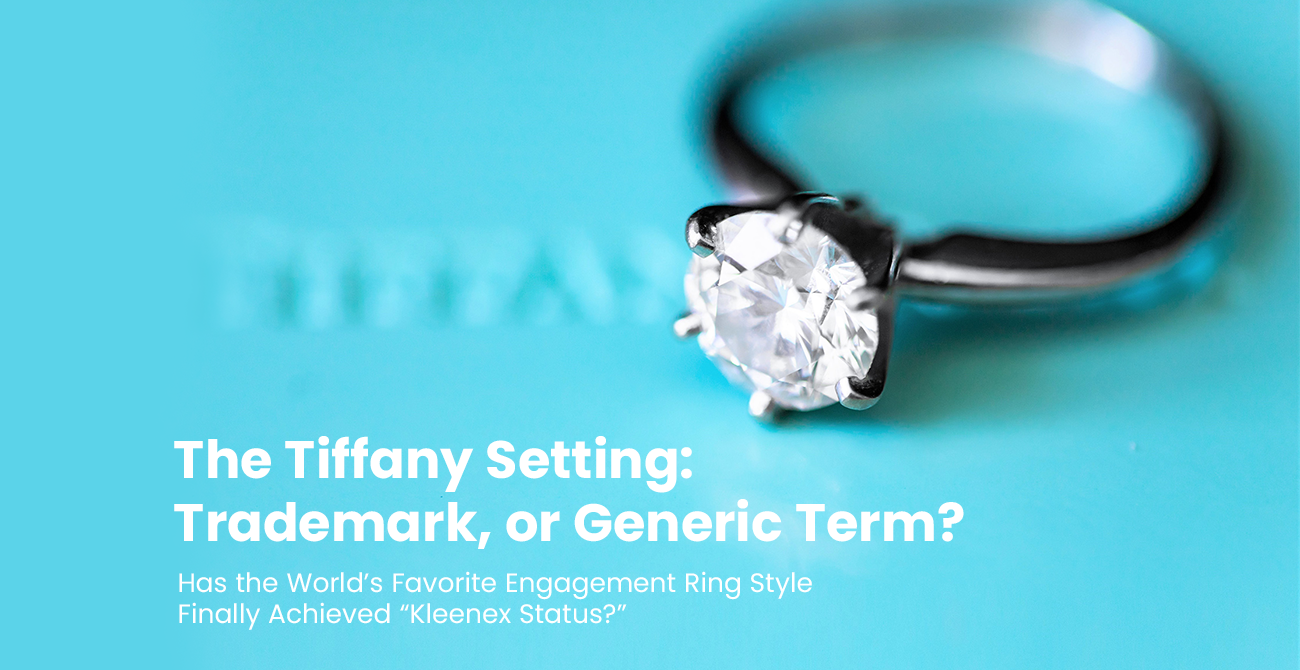
When Charles Lewis Tiffany was looking for a ring with more “shine” he ended up inventing the world’s favorite engagement ring style. Before the arrival of the Tiffany setting in 1886, all diamonds were set in a bezel, so only the crown was visible. To expose more of the diamond’s surface and enhance the stone’s sparkle, Tiffany and the company’s gemologists developed a new type of setting using several raised claws designed to hold a diamond securely while exposing much more of the stone for viewing.
This new style of setting, called “the most brilliant ring ever” by fans, quickly became the world’s favorite type of engagement ring. The ubiquitous Tiffany Setting is now so popular that it is used colloquially throughout the jewelry industry to describe any multi-pronged solitaire ring setting. Although many now think the term Tiffany Setting has reached “Kleenex status” and become a generic part of the language, Tiffany & Company does not agree.
When Does A Brand Name Become A Generic Term?
The issue of whether the word “Tiffany” is now a generic term for these popular ring settings has now reached a New York federal judge. Tiffany & Company has sued discount giant Costco for selling counterfeit rings that it claims are falsely advertised as Tiffany. Costco denies the claim, saying that the company never intended to sell “Tiffany rings,” only unbranded rings having a generic Tiffany style setting. “Our rings have no brand name embossed on them, are returnable at Costco, and come with a Costco appraisal,” said a Costco spokesperson. To bolster their claim, Costco has point out that popular books like Wedding Planning for Dummies and Dictionary of Gems and Gemology, as well as advertisements from many retailers already use the term “Tiffany setting” generically.
Tiffany & Company still thinks that the setting invented by company founder Charles Lewis Tiffany is theirs and theirs alone. “When Costco used the Tiffany trademark to refer to goods that had nothing whatsoever to do with Tiffany & Company, they infringed Tiffany’s trademark, while damaging both their own customers and the Tiffany brand,” said company spokeswoman Linda Buckley.
Litigation as a Form of Manipulation
Did Costco customers really think they were buying a Tiffany ring? Or is this just another frivolous lawsuit designed to preserve the stature of the luxury jeweler? Our language is constantly evolving. Many brands and slogans that were once exclusive to a manufacturer have become generic trademarks. Can you imagine not being able to use the term Band Aid, Frisbee, Kitty Litter, Thermos, Kleenex, Ping Pong, Velcro, and Q-Tip? These are all popular brand names that have become generic as a result of their popularity and widespread use. Will the term “Tiffany setting” become the next to join the growing list of names that have simply become part of the language? Costco says the term has already become generic. Tiffany & Company disagrees. Now it’s up to a judge to decide. One thing is certain. This law suit provides for many people another good example of excessive litigation in the United States.
About Gevril Group
Gevril Group is the exclusive US representative for select European watch brands, distributing and servicing luxury, fashion and sports timepieces at a wide range of price points. Gevril Group also operates a full-service watch repair department staffed by master Swiss watchmakers.
Please subscribe to the Gevril Group newsletter and blog updates. Reader comments are welcome.
The Swiss Made Dispute
![]() |
What Wakes a Swiss Watch “Swiss?”
Even the Swiss Aren’t Sure These Days
The words Made in Switzerland can almost double the price of a luxury watch. For hundreds of years Switzerland has been regarded as the pinnacle of watchmaking expertise and watch aficionados around the world have been ready and willing to pay significantly more for a timepiece manufactured in Switzerland.
All that may be changing, since current Swiss laws governing what constitutes a Swiss watch are ambiguous at best. Currently, only 50% of the value of a watch’s movement must be made in Switzerland in order to display the very desirable words “Swiss made” on the dial. This means that less critical watch components such as cases, straps and dials can be manufactured anywhere. It has been common practice for decades for many mid-sized Swiss watchmakers to buy these components in Asia, primarily in China. With a strong Swiss franc and much higher labor costs, only a few top luxury brands can afford to manufacture all of their components in Switzerland.
Many Swiss watchmakers say that current weak Swiss laws make it possible for watches produced almost entirely in China to be sold legally under the “Swiss made” label. These manufacturers want to replace current 40-year-old directive, which says at least 50% of the value of the watch movement must be made in Switzerland, with a new law that increases the percentage of Swiss made watch components to 60%. According to Jean-Daniel Pasche, chairman of the Swiss Watch Federation, the current weak law harms Swiss brands as customers learn their timepieces are not entirely Swiss. “Some people already complain their Swiss watches are not as Swiss as they should be,” says Pasche.
Not all Swiss watch manufacturers agree. Ronnie Bernheim, head of the popular Mondaine brand, says a 60% threshold could compel makers of lower-priced Swiss made watches like Mondaine to buy cheaper components abroad. The controversy continues to rage, with watchmakers like Mondaine on one side of the issue and others like 260-year old Vacheron Constantin on the other side.
While some well-known Swiss brands like TAG Heuer now openly admit buying movement parts from Seiko in Japan, the powerful Swiss Watch Federation has become so upset about lax support for higher standards that they recently resigned from the Swiss Business Federation. “By failing to support a 60% minimum rate of Swiss value in a Swiss product, The Swiss Business Federation not only stands in the way of strengthening the protection of the Swiss made label, it also raises the likelihood of it becoming weaker than it is at present,” says a Swiss Watch Federation spokesperson.
Nobody knows where this controversy will end, since there are many different economic interests involved. Mondaine’s Ronnie Bernheim fears that stricter regulations will threaten his business and force him to cut jobs. Julien Marchenoir, brand equity director at Vacheron Constantin says a strong Swiss made label will help keep watchmaking know how in Switzerland. TAG Heuer, on the other hands, doesn’t think using Seiko parts will hurt its Swiss made image at all.
According to the Reuters News Agency, the Swiss parliament is now debating two measures about how to define a Made in Switzerland product. The lower house has argued that 60% of the value must be manufactured in Switzerland for it to bear the “Swiss made” label, while the upper house thinks that 50% is enough. However before this issue is resolved, it’s safe to say that your next watch will probably have at least a few components made in Asia.
About Gevril Group
Gevril Group is the exclusive US representative for select European watch brands, distributing and servicing luxury, fashion and sports timepieces at a wide range of price points. Gevril Group also operates a full-service watch repair department staffed by master Swiss watchmakers.
Please subscribe to the Gevril Group newsletter and blog updates. Reader comments are welcome.
JC Penney Shares Plummet on Poor Quarterly Sales
![]() |
Who Determines the Future for JC Penney:
Ron Johnson, or His Customers?
Ron Johnson, the former Target executive who helped Steve Jobs create Apple’s wildly successful chain of retail stores, was recruited by activist investor Bill Ackerman in November of 2011 to apply his retail magic to ailing retailer JC Penney. Johnson told investors in January of 2012 that the transformation would take four years. Although corporate turnarounds are always difficult, Ron Johnson is not off to a good start. During the first year of his tenure, JC Penney stock has already declined by more than 60%.
Since his appointment as CEO, Johnson has delivered one disastrous quarter after another. According to Reuters, JC Penney shares dropped as much as 22% in a single day after the retailer announced a 31.7% decline in comparable sales during the important 2012 Winter holiday quarter. This dismal quarterly report follows a long series of similar earnings reports since Johnson began his transformation plan.
Ron Johnson’s Failed Attempt to Transform JCP
Forbes market analyst Steve Schaefer suggests that Ron Johnson’s biggest mistake have been putting too much faith in the rationality of the American consumer. “By eliminating sales, coupons and promotions,” says Schaefer, “Johnson figured the chain could offer competitive, everyday low prices, but he also eliminated the thrill of the chase.” JC Penney customers were not like Apple customers. They were very sensitive to pricing issues and loved the opportunity to buy something at 50% off.
Instead of trying to transform the store, many now think that Ron Johnson made the mistake of trying to transform his customers instead. Johnson was convinced that replacing popular sales events with “everyday low prices” while simultaneously rolling out dozens of branded boutiques within the store for “hip brands” would reverse JC Penney’s declining sales figures. Customers didn’t agree. Now, even staunch Johnson supporter Bill Ackerman concedes that removing the “anchor price” at JC Penney stores was a mistake. “Consumers don’t just know the right value,” says Ackerman. Many analysts now think that customers depended on sales and coupons to provide perceived value.
Although attempting to transform the modern retail environment may be a noble endeavor, it is one that investors seldom have patience for. Johnson may no longer have the time to complete his four-year transformation initiative. S&P has already cut JC Penney’s credit rating and the company is burning through cash reserves at an alarming rate. With JC Penney bonds falling to a record low after this quarter’s dismal earnings report, Bernie Sosnick, an analyst at Gilford Securities, said recently in a telephone interview “You’re getting down to a point where Penney cannot absorb many more significant losses without the damage becoming irreparable.”
The Power of the Consumer
According to watch industry insider and owner of Gevril Group owner Samuel Friedmann, the recent demise of JC Penney has many lessons for the watch industry. “You should never try to second guess your customer,” says Friedmann. “The customer is always right, and it is our job to listen to them and meet their needs.”
Does Ron Johnson still have time to learn this valuable lesson? The clock is already ticking and many think we’ll know the answer by the end of this year. Key investor Bill Ackman, whose hedge fund Pershing Square Capital Management currently owns 17.9% of JC Penney, has already said, “We won’t continue to pour billions into a strategy that’s not working.”
Johnson threw out the playbook when he eliminated cashiers at Apple stores and replaced them with geniuses, specialists, even a concierge. Maybe that’s not the answer for JC Penney however. In a year where Penney saw same-store sales drop by more than 25%, rival Macy’s actually enjoyed a 3.7% increase. This is strong evidence that sales and coupons may be here to stay.
About Gevril Group
Gevril Group is the exclusive US representative for select European watch brands, distributing and servicing luxury, fashion and sports timepieces at a wide range of price points. Gevril Group also operates a full-service watch repair department staffed by master Swiss watchmakers.
Please subscribe to the Gevril Group newsletter and blog updates. Reader comments are welcome.
Tiffany Sends Costco an Expensive Valentine
![]() |
Tiffany Accuses Costco of Engaging in Selling
Counterfeit Tiffany Engagement Rings
On February 14, 2013 luxury retailer Tiffany and Company filed suit against Costco Wholesale Corporation for engaging in selling counterfeit diamond Tiffany engagement rings at their Huntington Beach, California store. A customer alerted Tiffany that the discount giant had been selling diamond engagement rings clearly marked by in-store signage as “Tiffany.” A subsequent investigation revealed that the rings in question, one marked platinum Tiffany .70 cts. VS2 round and the other marked Tiffany VS2 1 ct. round were not Tiffany rings at all.
It is believed that hundreds, if not thousands, of Costco customers may still think they purchased a genuine Tiffany ring from Costco, since the retailer has apparently been selling different styles of rings for many years that it falsely identified on in-store signage as ‘Tiffany. “This is not the kind of behavior people expect from a company like Costco,” said Tiffany lawyer Jeffrey Mitchell. “Everyone knows that buying something on a street corner or over the Internet from an unknown source is risky. Until now, no one would have thought it could be risky to buy brand name merchandise from Costco as well.”
The Tiffany lawsuit seeks at least $2 million in damages, an injunction against Costco from using the Tiffany name, and asks Costco to “publicly admit its misconduct” to all customers who bought any rings labeled as “Tiffany.”
None of the rings identified at the Huntington Beach store as “Tiffany” were, in fact, genuine Tiffany rings. They were not manufactured by Tiffany. They were not approved by, licensed by, or in any way associated with Tiffany, according to the legal papers filed on Valentine’s Day in New York federal court.
Counterfeit Goods in the Luxury Industry
The luxury goods industry has always had problems with counterfeiting. Usually these counterfeit items are sold on street corners or over the Internet. Never before has a reputable retailer been accused of selling counterfeit goods in their own stores. The lesson for anyone thinking about purchasing luxury items like jewelry or watches is that it is still important to know where the merchandise comes from. It is always safest to buy directly from the manufacturer or one of their authorized representatives. If you don’t buy from an authorized source, you can never be sure of what you are getting.
Every year, luxury “fakes” get harder and harder to detect. That’s why it is more important than ever to buy rings, jewelry, watches, and other luxury items from a reputable source. To view Gevril Group’s list of authorized jewelers and fine watch dealers, visit the company’s Where to Buy web page. This page is not a fake! It’s simply the best way to find an authorized jeweler or watch dealer in your area.
About Gevril Group
Gevril Group is the exclusive US representative for select European watch brands, distributing and servicing luxury, fashion and sports timepieces at a wide range of price points. Gevril Group also operates a full-service watch repair department staffed by master Swiss watchmakers.
Please subscribe to the Gevril Group newsletter and blog updates. Reader comments are welcome.